












Pitch deck title and company name
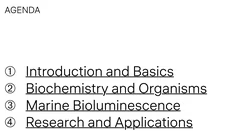
Table of contents with main sections

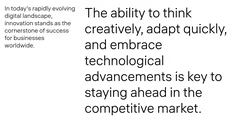
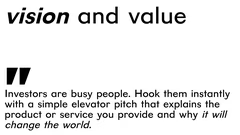
Vision and value proposition
Repeating vision and value message
Introduction to the problem
Detailed problem description
Statistical data and research findings
Key indicator showcase
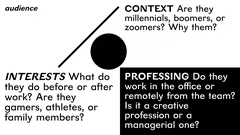
Target audience analysis
Introduction to the solution
Detailed solution description
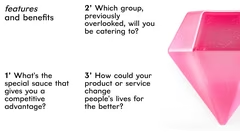
Product features and benefits
Repeating features and benefits
Business model and revenue streams
Current investors and partnerships
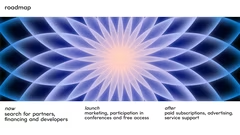
Company roadmap and milestones
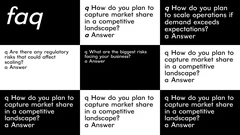
Frequently asked questions and answers

Company contact information

Investor Pitch Deck Guide

18 slides

A guide to using the 'For investors' template to create a pitch deck that will attract potential investors.

savage
View template

About the template

The 'For investors' template is a tool for creating a pitch deck that will attract potential investors. It contains slides for describing the company's vision, the problem and its solution, research results, target audience, business model, development roadmap and other important aspects. The template uses text blocks, tables and visual elements to emphasize key points.

Creating a vision and value proposition slide is key to catching an investor's interest from the outset. The slide should include a brief description of the product or service and its market impact. It's important to highlight the unique advantages of your solution and use clear language without professional jargon. Keep the information concise and avoid unnecessary details. To convince investors of the relevance of your solution, show them the problem it addresses. Create a slide that describes the issue and its effect on people or businesses. Use specific examples and data to demonstrate how widespread and serious the problem is. Show why the target audience needs a solution and what negative consequences (costs, inefficiencies) your product or service will help to eliminate. Supporting your arguments with research and data is essential. Use charts and statistics to illustrate trends. Arrows and special characters can help to emphasize changes in key indicators. Make sure to cite reliable sources and provide additional context where needed. Use percentages and ratios to make your data more convincing and directly relate it to your value proposition. The business model and roadmap slides should explain how the company will earn money and develop. Describe your pricing policy, target customer groups and costs. The roadmap should show the main stages of development: from current activities (for example, searching for partners and funding) to future plans (launching marketing campaigns, introducing paid subscriptions). Add an FAQ section to answer common investor questions and show that you have considered all possible issues.

FAQ

  • How to use colors to highlight information?

    Use contrasting colors to emphasize key points. Avoid overloading slides with bright shades and maintain a consistent design style. Colors should aid understanding, not distract.

  • How to properly structure presentation slides?

    Each slide should focus on a single main idea. Use headings, brief bullet points, and visuals to support it. Group slides logically so that information flows sequentially.

  • How should text be formatted in a presentation?

    Use large fonts, avoid long paragraphs, and highlight key points. Ideally, keep 6–7 lines of text per slide. Ensure high contrast between the background and text.

  • How can I make a presentation easy to understand?

    Break information into sections, use headings, concise bullet points, and visuals. Follow a clear structure: introduction → main content → conclusions.

  • How to quickly prepare a presentation?

    Use a ready-made template and select 5–7 main slides. Focus on key facts and striking examples. Don’t aim for perfection — a clear, ready version is better than a delayed, overloaded one.