Limit of functions
Instructor:​ Begli Akmyradov Student:​ Nuryyev Resul
Content 1.​ Introduction to the concept of a limit 2.​ Formal definition of a limit 3.​ One-sided limits 4.​ Limits at infinity 5.​ Techniques for evaluating limits 6.​ Indeterminate forms and L'Hôpital's rule 7.​ Epsilon Delta Definition Of A Limit 8.​ Limits and continuity 9.​ Limits in real-world applications 10.​ Examples of limit problems 1.​ Summary and importance of limits
Introduction to the concept of a limit
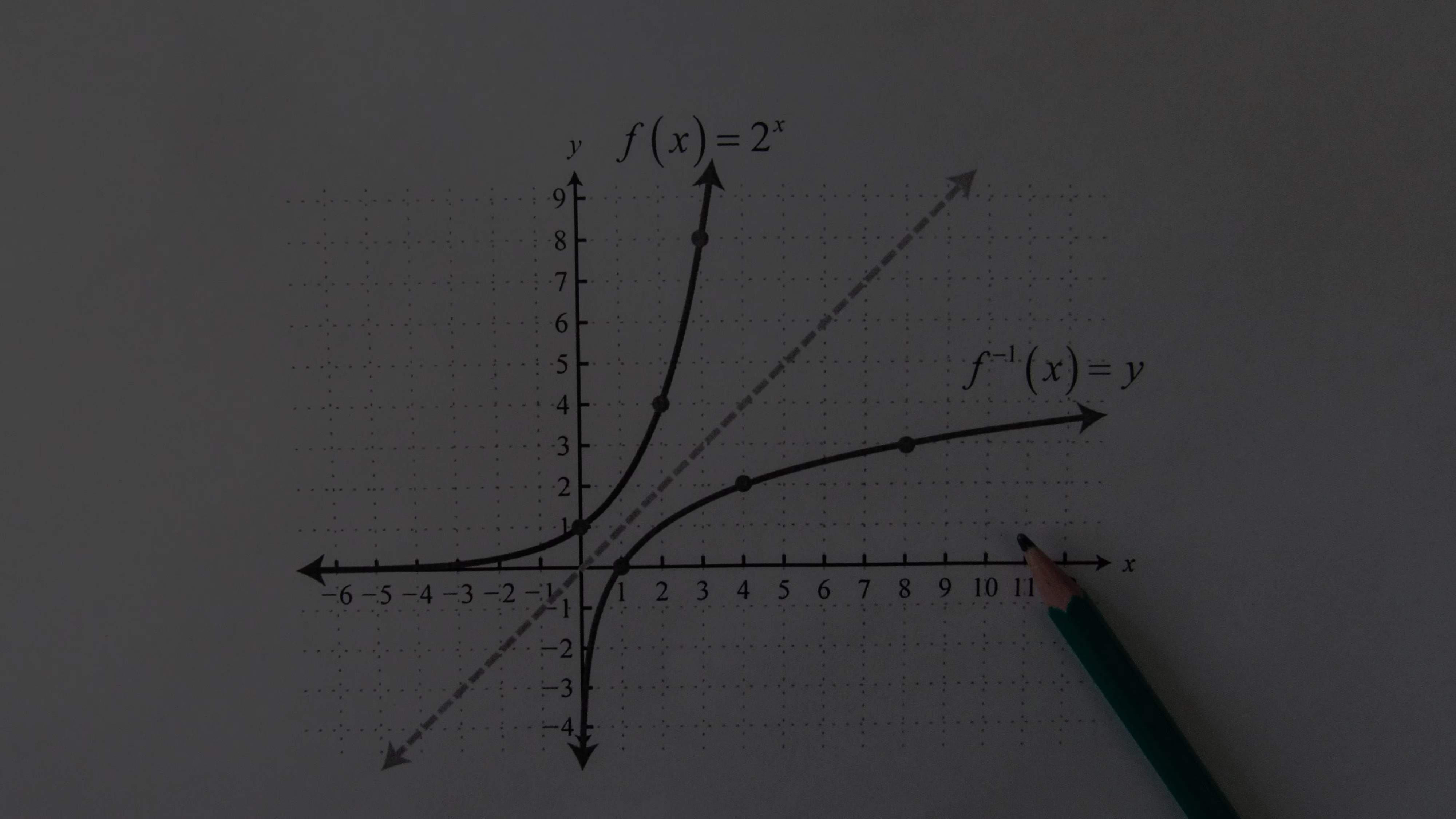
The concept of a limit is fundamental in calculus and mathematical analysis.​It describes the behavior of a function as its input approaches a certain value.​ The notion of a limit has many applications in modern calculus.​ In particular,​ the many definitions of continuity employ the concept of limit:​ roughly,​ a function is continuous if all of its limits agree with the values of the function.​ The concept of limit also appears in the definition of the derivative:​ in the calculus of one variable,​ this is the limiting value of the slope of secant lines to the graph of a function.​
Introduction to the concept of a limit
Limits are used to define continuity,​ derivatives,​ and integrals.​ Understanding limits is crucial for solving problems in physics,​ engineering,​ and economics,​ where we often need to analyze how quantities change and approach specific values.​ The notation lim_x → a f(x) =​ L means that as x gets closer to a,​ the value of f(x) gets closer to L.​ Limits help us understand the asymptotic behavior of functions and are the basis for more advanced mathematical concepts.​
Formal definition of a limit The formal definition of a limit,​ often called the ε-δ definition,​ provides a rigorous way to understand limits.​ It states that for every ε > 0,​ there exists a δ > 0 such that if 0 <
One-sided limits
One-sided limits are limits where the input approaches a certain value from one side only — either from the left (x approaches a from values less than a) or from the right (x approaches a from values greater than a).​ They are denoted as lim_x → a^- f(x) and lim_x → a^+​ f(x).​ One-sided limits are important for understanding the behavior of functions at points where the function may have different behaviors from different sides,​ such as piecewise-defined functions or functions with vertical asymptotes.​If the left-hand and right-hand limits exist and are equal,​ then the two-sided limit exists.​
Limits at infinity Limits at infinity describe the behavior of a function as the input variable grows without bound (approaches positive or negative infinity).​ We write lim_x →∞ f(x) =​ L or lim_x → -∞ f(x) =​ L to indicate that f(x) approaches L as x becomes very large in the positive or negative direction.​ Limits at infinity are crucial for analyzing the end behavior of functions,​ identifying horizontal asymptotes,​ and understanding the long-term trends in mathematical models.​ They are widely used in economics,​ physics,​ and engineering to study systems over long periods or large scales.​
Techniques for evaluating limits
There are several techniques for evaluating limits,​ including direct substitution,​ factoring,​ rationalizing,​ and using the squeeze theorem.​ Direct substitution works when the function is continuous at the point of interest.​ Factoring is useful for simplifying rational functions and removing indeterminate forms.​
Rationalizing helps when dealing with square roots in the numerator or denominator.​ The squeeze theorem is powerful for evaluating limits of oscillating functions by bounding them between two other functions.​ Mastering these techniques allows for the efficient evaluation of a wide range of limits.​
Techniques for evaluating limits
Rationalizing helps when dealing with square roots in the numerator or denominator.​ The squeeze theorem is powerful for evaluating limits of oscillating functions by bounding them between two other functions.​ Mastering these techniques allows for the efficient evaluation of a wide range of limits.​
Indeterminate forms and L'Hôpital's rule
L'Hôpital's rule is a powerful tool for resolving indeterminate forms of the type 0/​0 and ∞/​∞.​
It states that if lim_x → af(x)/​g(x) is an indeterminate form,​ then lim_x → af(x)/​g(x) =​ lim_x → af'(x)/​g'(x),​ provided the limit on the right exists.​ L'Hôpital's rule can be applied repeatedly if necessary,​ but it is important to check that the conditions for its use are met.​
How we apply l’Hoptial’s rule
Epsilon Delta Definition Of A Limit
The formal definition of a limit,​ which is typically called the Epsilon-Delta Definition for Limits or Delta-Epsilon Proof,​ defines a limit at a finite point that has a finite value.​First,​ we create two variables,​ delta (δ) and epsilon (ε).​ Next we choose an epsilon region around the number L on the y-axis.​ Then,​ we use this region to help us define a delta region around the number a on the x-axis so that all x-values,​ excluding a,​ inside the region correspond to y-values inside the epsilon region.​ Finally,​ we show (prove) that we can find y-values of the function as close as we want to the value L by using only the points in a small enough interval around a.​
Examples of Epsilon Delta limit
Limits and continuity
A function f(x) is continuous at a point x =​ a if lim_x → a f(x) =​ f(a).​ Continuity is a fundamental property of functions that ensures there are no abrupt changes or jumps in the function's value.​ Understanding the relationship between limits and continuity is crucial for analyzing the behavior of functions,​ especially in calculus and real analysis.​
Continuity
Informally,​ if you can sketch a graph without lifting your pencil off the paper,​ then we say that function is continuous.​ Otherwise,​ we declare a function is discontinuous.​ There are four types of discontinuity:​ Removable (Point) Infinite (Asymptote) Jump Oscillating.​
Limits in real-world applications
Limits have numerous applications in the real world,​ including in physics,​ engineering,​ economics,​ and biology.​ In physics,​ limits are used to describe the behavior of physical systems as they approach certain states,​ such as the speed of an object as time approaches a certain moment.​ In engineering,​ limits help analyze the stability and performance of systems under various conditions.​ In economics,​ limits are used to model the behavior of markets and the effects of changes in variables like price and quantity.​ In biology,​ limits can describe the growth of populations or the spread of diseases over time.​
Finding Limits Graphically
Examples of limit problems Here are a few examples of limit problems to illustrate the concepts discussed:​ 1) Find lim_x → 2x^2 - 4/​x - 2; 2) Evaluate lim_x →∞(1 +​ 1/​x)^x; 3) Determine lim_x → 0sin(x)/​x.​
These examples demonstrate the use of different techniques for evaluating limits,​ including factoring,​ recognizing standard limits,​ and applying L'Hôpital's rule.​ Solving such problems helps build intuition and skills in working with limits.​
Applications of Limits in the Business Field
In the business field,​ the concept of limits plays a crucial role in helping businesses optimize performance,​ forecast trends,​ and make critical decisions across various domains.​ Below is a more detailed breakdown of how limits are applied in different areas of business:​ Marginal analysis:​ Limits are used to calculate marginal cost and marginal revenue,​ which help in determining pricing and optimizing production.​ For example - A company may use limits to understand how the cost of producing an additional unit change as production scales up.​ Risk management:​ Limits are used to make model portfolio optimization,​ option pricing,​ and to calculate the value of risk.​ For example - A company or investors can use limits to assess the value of the option under different market condition.​ Demand Elasticity:​ Limits are used to analyses how demand changes with price,​ aiding pricing strategies.​ This is crucial for setting an optimal price and determining how a small price change can change the volume of sales.​ For example - A company use limits to determine if lowering the price of the product by a small amount will significantly increase the sale,​ help in deciding best price to maximize revenue.​
Summary and importance of limits
Limits are a cornerstone of calculus and mathematical analysis,​ providing a framework for understanding the behavior of functions and sequences.​
They are essential for defining derivatives and integrals,​ which are fundamental in solving real-world problems in science,​ engineering,​ and economics.​
Mastering the concept of limits opens the door to more advanced mathematical topics and applications.​ The ability to evaluate limits and understand their properties is a key skill for any student of mathematics or related fields.​
Sources 1.​ https:​/​/​cdn.​pixabay.​com/​photo/​2022/​06/​02/​07/​29/​infinity-7237232_1280.​png 2.​ https:​/​/​yourhealthforumbydrcirino.​org/​wp-content/​uploads/​2024/​02/​89d07-fractal_1619460055.​jpeg 3.​ https:​/​/​cdn.​sanity.​io/​images/​7i1ps9pf/​production/​920ada9b795fa4ef49adc49de44a4db0f52791ed-4459x2508.​jpg 4.​ https:​/​/​i.​pinimg.​com/​originals/​f0/​6f/​99/​f06f99ea61492b708f8414c74e4194b5.​jpg
Thanks for attention.​